
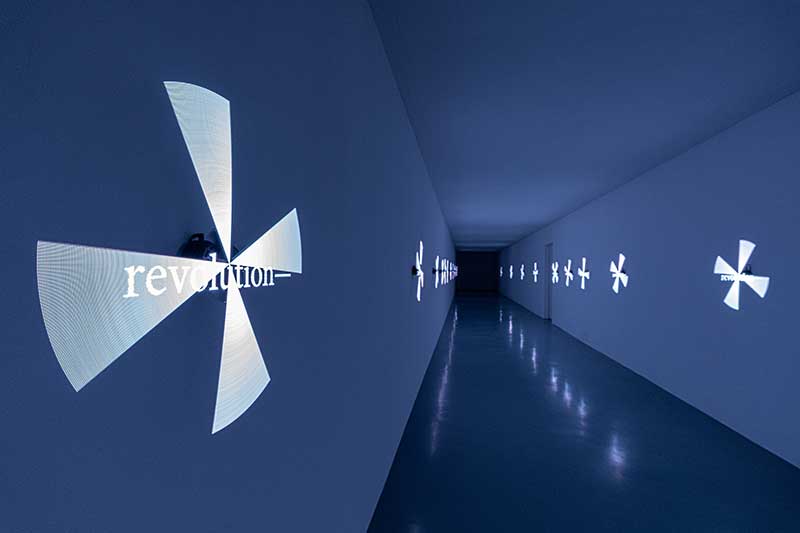
Astrup Fearnley Museet presents a major light art exhibition featuring the work of Cerith Wyn Evans, Ann Lislegaard, and P. Staff.
Their immersive environments, architecturally scaled video projections, and luminous sculptures—fashioned from repurposed consumer, medical, and industrial lighting—transform the museum’s galleries and stimulate the senses.
Taking a cue from the strategies of the artists in this exhibition, Grammars of Light choreographs works in dialogue with the unique architecture of Astrup Fearnley Museet. Each installation is provided with a dedicated space, yet rather than isolating practices, works overlap each other, encouraging encounters between and among practices and ideas.
The exhibition begins with P. Staff’s video Penetration, entangling light with the body politic, the built environment, and the medical field. Presented on a screen stretching from floor to ceiling, a medical laser is projected onto a shirtless figure’s abdomen and into their viscera. At once visually daring, unsettling and erotic, the work externalizes the interior of this body, blurring the boundaries between interior and exterior. The light falls both onto and inside the figure.
Ann Lislegaard’s Crystal Worlds (after J.G. Ballard), a digital animation that brings together science fiction and Brazilian modernist architecture, is presented on the museum’s upper floor. In the work, British writer J.G. Ballard’s The Crystal World meets the architecture of Lina Bo Bardi and Oscar Niemeyer. In Ballard’s apocalyptic novel, the world is undergoing a process of crystallization—forests, people and villages are being turned into light—yet Lislegaard resists this spectacular image through measured pacing and a restrained, monochrome language. Instead, the shadowy world that she develops becomes a space to imagine other possibilities and trajectories.
Cerith Wyn Evans’ installation StarStarStar/Steer (Transphoton), newly adapted for this exhibition, is presented in the museum’s central gallery and mezzanine. Formed of six pillars of LED lights, echoing Doric columns, and dispersed throughout the space, the work pulsates at alternating intensities. It grows either more intense or dims according to a series of predetermined chance operations controlled by an algorithmic program, in a nod to the composer John Cage. Evans’ luminous environment, visually captivating yet conceptually elusive, reorients the viewer away from the enclosure of their own experience into a dynamic process of encounter, as they move through and around the installation.
February 6 – May 10 2026
Astrup Fearnley Museet, Oslo
PM: ARTPRESS – Ute Weingarten
Foto: P.Staff, Minimum World.
Bonner Kunstverein.
Foto: Niklas Goldbach